
Taliaferro County Arrest Warrants Explained
An arrest warrant is a judge's order that lets officers take a named person into custody. In Taliaferro County, Magistrate Court is named outright as a court that issues arrest and search warrants. Before signing, the judge must find probable cause. That means enough facts to reasonably believe an offense happened and that the accused committed it. An accusation by itself is not that finding. Law enforcement usually brings a sworn complaint or affidavit. A private person follows a more specific local route the sheriff describes: file a police report first, then seek a pre-warrant hearing if police decline to prosecute. If the warrant issues, the arrest follows. The charge itself still has to move through the proper court in Taliaferro County.
Taliaferro Pre-Warrant Hearing Steps
The sheriff's warrant-process explanation lays out a clear local sequence. When Magistrate Court accepts a private application in Taliaferro County, it sets a hearing and notifies the accused. The applicant presents testimony and evidence. The accused can attend, hire counsel, question witnesses, and offer evidence too. Both sides are advised of the right to counsel and the right to remain silent.
- Obtain a police report and preserve the facts and evidence.
- Ask Magistrate Court whether it will accept a private warrant application.
- Attend the noticed hearing and present sworn evidence.
- Wait for the judge's independent probable-cause decision.
If the warrant issues, the applicant signs as prosecutor and certifies the information. Knowingly false claims can expose the signer to false-swearing or perjury consequences. The Taliaferro County page mentions an application fee but gives no amount; domestic-violence applications carry no fee.
Inside a Taliaferro Arrest Warrant
Taliaferro County publishes no completed warrant sample or public field schema. The official process supports these elements only at a conceptual level. Exact labels, number format, charge codes, and status terms must come from the issuing court, not from a made-up example.
| Record identifier | A court or warrant number may identify the file, but no local public format was located. |
|---|---|
| Named subject | The person whom the order authorizes officers to arrest. |
| Charge or offense | The allegation supported by the probable-cause submission, not a finding of guilt. |
| Issuing court | The judge and court that control later bond, recall, quash, or hearing questions. |
| Bond conditions | Any amount or special pretrial terms set by the judicial officer, if the public record discloses them. |
| Service event | Whether an arrest or return has been recorded; the county publishes no status dropdown. |
Taliaferro Felony Court Handoff
Magistrate Court is the local entry point for warrants and preliminary matters, while the Clerk of Superior Court keeps the Superior criminal filings. After a felony arrest, a preliminary hearing can test whether probable cause supports moving ahead. Grand-jury work stays private. An indictment then shifts the felony prosecution into Superior Court. The Toombs Judicial Circuit District Attorney prosecutes felonies for Taliaferro County and five other counties. A sealed indictment is not a public warrant lookup. A sealed charging instrument, or an arrest order tied to it, may stay out of public case access until a court permits disclosure. Call the clerk at 706-456-2123 for file direction, but use counsel when disclosure or custody is at stake.
Serving Arrest Warrants in Taliaferro County
The Taliaferro County Sheriff's Office is the only local agency the official site specifically names as serving criminal warrants. It also runs the jail, transports prisoners, and provides court security. County planning sources mention Crawfordville Police and Georgia State Patrol. None publishes a division map showing which agency serves each warrant. No constable or city-marshal role should be inferred. Service can happen during direct contact or any other lawful police encounter. After an arrest in Taliaferro County, booking generally records identity, the alleged offense, fingerprints, a photograph, property, and holding location. Someone who cannot obtain release may request a preliminary or commitment hearing. The State must then establish probable cause again. Local material promises no fixed 24-hour or 48-hour hearing deadline.
Taliaferro Sheriff Confirmation Route
Taliaferro County offers no public arrest-warrant search form. The online-services area stays limited, and Most Wanted covers only selected felony fugitives. For your own status or a relative's matter, call the 24-hour sheriff line at 706-456-2345. Have the full legal name, date of birth, likely county, and any case number ready.
Ask which agency holds the order, which court issued it, and whether bond or appearance terms exist. Ask where the person has been told to report. An in-person status check can turn into immediate custody. Calling first does not cancel the Taliaferro County warrant, but it helps counsel and the court plan the lawful next step.
Taliaferro Arrest Record Access Limits
A court file and a warrant-status check answer different questions. Georgia Courts e-access lists a provider route for Taliaferro Superior Court, but an account-based case search is not the sheriff's active-warrant index. New, sealed, and restricted matters may not appear. Juvenile information moves through a restricted clerk or counsel channel, not a public arrest-warrant search. When a phone answer falls short, a written request under the Georgia Open Records Act can seek an existing, non-exempt record from the proper custodian. Identify the person, likely court, approximate date, and known case number. Do not ask the office to create a new list. The custodian may cite exemptions, search or copy costs, and availability. Verify status with the issuing court and the Taliaferro County sheriff either way.
Taliaferro Arrest Orders Compared
Not every court paper works the same way. An arrest warrant authorizes custody based on probable cause of an offense. A summons just tells someone to show up, with no arrest ordered first. A bench warrant usually follows a missed hearing or another broken court duty. Whatever the label, the issuing court's docket controls, so check Taliaferro County bench warrant information and confirm the actual paperwork before acting on it.
| Feature | Arrest Warrant | Summons | Bench Warrant |
|---|---|---|---|
| What it orders | Custody | Appearance | Custody for a missed duty |
| Basis | Probable cause | Notice to answer | Failure to appear or comply |
| Issuer | Judge or magistrate | Court or authorized officer | Judge controlling the case |
| Response | Counsel, surrender, bond | Appear as directed | Reset, recall, appearance |
Taliaferro Booking and Hearing Path
Booking starts the paper trail after an arrest. It records the event; it decides nothing. Some minor matters skip booking entirely, with a citation and a promise to appear where the law allows. Once a person is booked on an arrest warrant, the practical questions pile up fast: who is holding them, will bond be set, which court comes next, and when is the hearing. Pretrial conditions may also apply, restricting contact or conduct, and breaking them invites more court action. A preliminary hearing comes next in many cases. There, a judge hears testimony and weighs whether probable cause supports going forward. It is not a trial. Felony cases can move on to a grand jury and then arraignment in the Superior Court of Taliaferro County, where the charge and rights are stated and a plea is entered. Release on recognizance, a bail change, or continued custody rests with the court in Taliaferro County, not with any generic web result. For the county's own explanation of probable cause, read the official source page, which lays out the warrant process without touching any person's record.
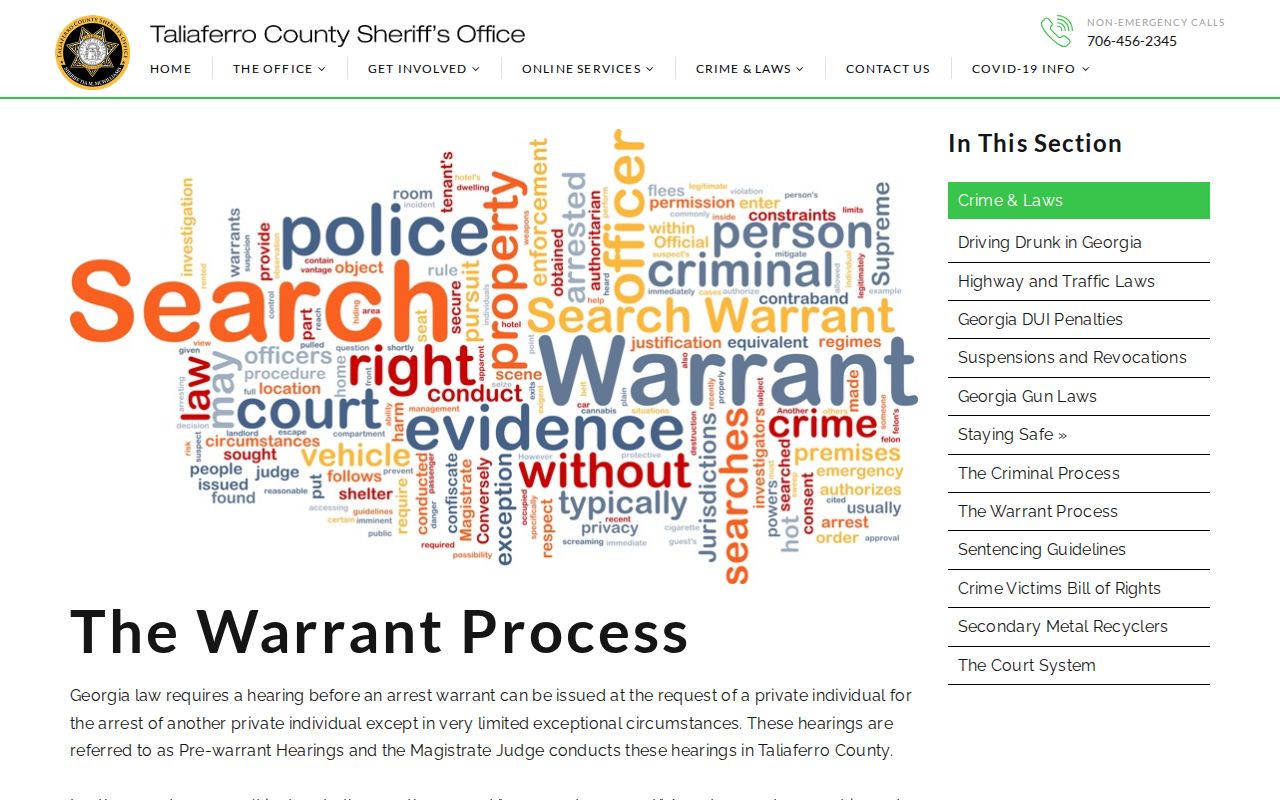
That framing helps. It walks through Taliaferro County's judicial steps while leaving names, images, and private case details out.
If You Have a Taliaferro Arrest Warrant
Start by confirming the warrant with the sheriff and the issuing court. Then talk to a defense lawyer or a public-defender contact before you walk in. Counsel may arrange a voluntary surrender, a bond review, a new hearing, or a motion to recall or quash. Recall means the court withdraws the warrant. Quash means the court sets it aside. A clerk can tell you the status but cannot cancel a judge's order alone. Taliaferro County runs no local surrender window, bond schedule, recall form, or amnesty program. If the sheriff directs a surrender, confirm the place and time first. The sheriff sits at 758 Warrenton Road SE; the courts sit at 113 Monument Street. Those addresses are not interchangeable. Bring identification, and after bond, an appearance, or a ruling, ask for written proof and confirm the sheriff's service record shows the update.
Important: Speak with counsel before surrender. An active warrant can lead to custody during any lawful contact with police.